School Library Journal
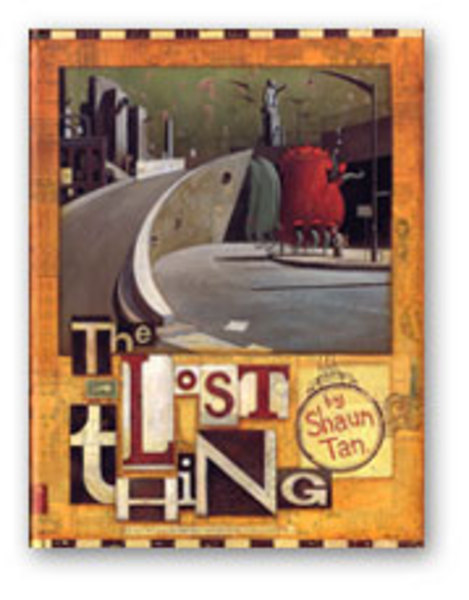
Tan's collage artwork for this picture book is full of the wonderfully strange. When a humungous "lost thing" at the beach catches the eye of a boy previously occupied with his bottle-cap collection, no one else seems to notice–not even his parents, although it takes up a good part of their living space when he brings it home. The boy sets off to find a place for the thing within an industrial landscape awash in gray matter–pipes, gears, and a few concrete structures. On the periphery of the central illustrations are postcards, road signs, words and diagrams from an engineering textbook, and faux governmentflierssuch as the one from "The Federal Department of Odds & Ends," where the motto is "sweepus underumcarpetae." Readers are bound to become adept perceivers as they move through the book and delight in discovering these exterior notes. Tan's illustrations offer playful tributes that could serve as introductions to such artists as Miró, Duchamp, Dalí, Kandinski, Hopper, John Brack, and Jeffrey Smart. This book asks important questions: What does it mean to see things differently? What is important to notice? The lost thing suggests that what can not be fit neatly into a box has great potential to wake us (if we pay attention) and help us see the world anew. Tan is a singular talent.
Kirkus
A familiar plot gets a novel setting and cast in Tan's first solo outing. A young narrator recalls finding a lost item on the beach one day. After failing to identify its original owners, or to secure parental permission to keep it, he nearly consigns it to the tender mercies of the Federal Department of Odds and Ends (Motto: "sweepus underum carpetae"), before discovering an altogether better home. The fact that the "item" looks like an octopus and a huge hermit crab living together in a giant red teapot is but one of many visual twists here. Lad and Thing wander through a city of bare concrete walls and drab, stiffly oblivious adults-all dingily lit and placed against full-bleed collages composed of hundreds of small, clipped swatches of printed text and quirky newspaper ads. At last the child ushers his companion through an out-of-the-way door to a land where similarly surreal creatures cavort, and returns to sorting his bottle-top collection. Like David Christiana's art, or Colin Thompson's, the mix of familiarity and strangeness here will pull readers into a tantalizingly different world.