Understanding self-worth
Written for young children in the four-to-nine age range, “The Boy from the Sun” is a simple, but important children, but can also be enjoyed by adults who can read it aloud.
Told in simple words and illustrated with watercolor paintings that grow richer and brighter as the story goes on, The Boy from the Sun tells of three children who are sad and bored in a black-and-white world. A boy with glowing yellow hair falls from the sky and takes the children on a magical journey through the forest.
As they move from a world of grey to a paradise of joyous colours, the children learn from their new friend about the importance of understanding self-worth and of remembering, always, that each person can choose a view of self that transforms the world.
The Boy from the Sun follows Weller’s previous works, Night Wall and Spacesnake. His paintings are lyrical and repay close attention, and his work will be featured in a retropective show at Thunder Bay Art Gallery next year.
His DVD contains four stories: Night Wall, The Boy from the Sun, The Ug and the Drip, and the Love Ant. These stories have been seen by hundreds of Thunder Bay School Children over the past few months.
School Library Journal
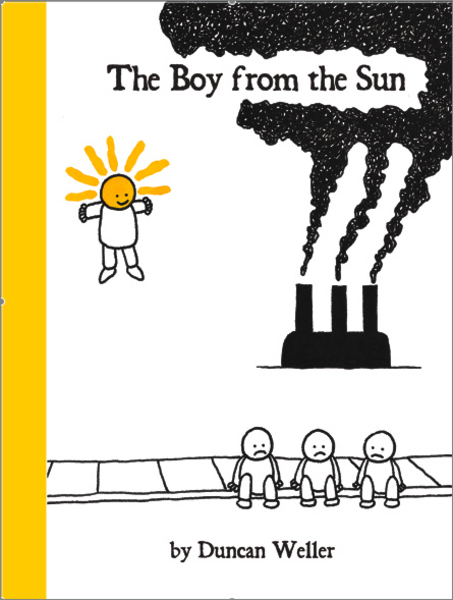
With minimal text and compositions that include black-and-white caricatures (and scenes), as well as colorful panoramas in a more realistic vein, Duncan Weller has created a fresh and visually rich environmental fable in The Boy from the Sun (Simply Read Books, 2007, Gr K-2). Preceded by dazzling yellow endpapers, the story opens to a spare white background and three sad, young figures, outlined in black, sitting on a sidewalk. Their backs are to a factory that is churning out black puffs of smoke. A fourth figure floats down from the sky; his head is yellow, and he is smiling. The newcomer proceeds to show them a bird, diverse groupings of people, grass, and finally—following the black-and-white sidewalk through the buildup of colorful page turns—a wonderland of natural beauty that bleeds off the pages as the children romp through them. Much of the story is wordless, but toward the end, the sunny figure recites a poem in which he tells his friends that change is possible. This title lends itself to discussion, and there is much to see, including hidden surprises.
Canada Council for the Arts
"This charming, fresh and joyful book perfectly melds story and image, to both deliver its message and form a thoroughly satisfying whole"
Montreal Families - "Books that reflect Canadian Heritage"
This admittedly strange and quirky book will immediately charm readers with its simple magic. Sad looking children with dark faces sit listlessly on the sidewalk while noxious fumes from factory smokestacks rise into the air. That is until the boy from the sun descends from the sky with his bright yellow beacon. He shows the children how to love nature and the playful joys it has to offer. By the time the boy returns to where he came from, the children have become aware of the importance of protecting their natural environment. Despite its simplicity, this Governor-General nominated book transmits a crucial theme to children about the environment, which is critical for Canadian society as we are one of the worst polluters in the world. Perhaps this future generation will reverse that trend.
Montreal Gazette
Many years ago, a neighbour told me that some of the most interesting, cutting-edge art of the day was being created for children's books. He was an artist himself, so I started looking at picture books with a fresh and more critical eye.
The result has been decades of pleasure. And when it comes time for the annual Governor General's Literary Awards for illustration (and, south of the border, the Caldecott Medal), I sit up and take notice.
This year, most of the artists nominated on the English side were familiar to me. (There is a separate GG Award for illustrations of French-language children's books.) Not so, however, B.C. author/illustrator Duncan Weller, whose book The Boy from the Sun (Simply Read Books, $19.95) was a surprise.
At first glance, it's an unassuming volume with a black-and-white (and yellow) illustration on its cover, and no dust jacket. Inside, it opens with a bleak image of three children perched on a sidewalk while a factory behind them belches black smoke. Not surprisingly, they look sad and glum -- until a figure "with a big yellow shining head" suddenly floats down from the sky and offers to show them something special. It's a colourful, detailed firebird, and the three kids immediately perk up.
The sun boy offers to show them more, beginning with a colourful cavalcade of people and birds that wheel about overhead. "Follow me," the boy says, and they do -- eagerly.
Four vibrantly coloured, richly illustrated double-page spreads follow, and by the time Weller adds text (a poem about art and change and celebration), the three (apparently named Chance and Choice and Change) find themselves at one with nature, frolicking in the autumn leaves while the factory sits silent and inactive in the distance. An allegory of sorts about the evils of urban blight versus the joys of nature's beauty, this is an odd little book but a welcome presence in the list of GG nominations for illustration. - Bernie Goedhart
Cheryl Rainfield's Children's Book Review
Imagination can take us into wonderful places, and bring greater beauty and happiness to even painful situations. In The Boy from the Sun , three children sit, lonely and sad in a cold city, until a boy with a sun for a head comes down from the sky and shows them delights--a beautiful bird, flying children, whole cities of people and animals within trees, and lush greenry. As they follow the sun-boy along the sidewalk, the sidewalk begins to curve and change, and then disappears altogether. The sun boy tell the children that they can use their minds and creativity to change their lives, find new paths to take. And the children do. The Boy from the Sun suggests that we can all open our minds to creativity and inner imaginings to discover more choices and bring ourselves greater happiness. This is an inspiring, feel-good book, on many levels.
Weller's text is, for the most part, sparse, without unnecessary detail, and thus moves quickly. Some pages have no text at all, and rely on the illustrations to carry the story forward, which they successfully do. Weller immediately engages reader empathy and identification by telling us that the children are sad, and that the day is a cold grey one, as well as by showing us the sad, lonely children in the illustration, each looking away from the others, together yet isolated and still. The children are never named, which I like; it leaves more room open for the reader to identify with them (and also leaves their gender up to the reader).
At times the text feels a little too simple; I would have liked a bit more lyrical word choices--but it works. A rather long poem near the end of the book stopped me; it didn't fit the flow of the rest of the book, which had little to no text on the pages. The placement of the poem felt slightly forced. Yet I found the poem beautiful, and it spoke to me; I just wish it was a stanza shorter.
The poem suggests that using your mind and creativity, you can open up the world for yourself, find new paths to travel, and that by filling your inner world, you'll find a greater place in the outer world. It directly tells the reader that 'you are worth celebrating," which is a wonderful message. These are all such important things to hear--I just wish it was sprinkled more throughout the book, instead of given all at once. There's also a slight feeling of telling that puts me off, but there was only one phrase that felt a bit preachy to me: "You are worth elevating." I could have done without that.
Weller creates an almost perfect partnership between the text and the illustrations, with each adding meaning to the other. The opening text, with the children sad on "a cold grey nothing sort of day" works beautifully with the black-and-white simple line drawings, heavy dark lines outlining the children, lots of white space that seems cold, especially with the cement sidewalk the children sit on, and the heavy blackness of the factories and smoke in the background. And the illustrations bring a great magic to the book.
Weller's drawings are evocative and beautiful. There's something about the simple black-and-white drawings, like a child's drawings, that show the sadness and creativity so well, and that make the movement into color and dreams all the more powerful.
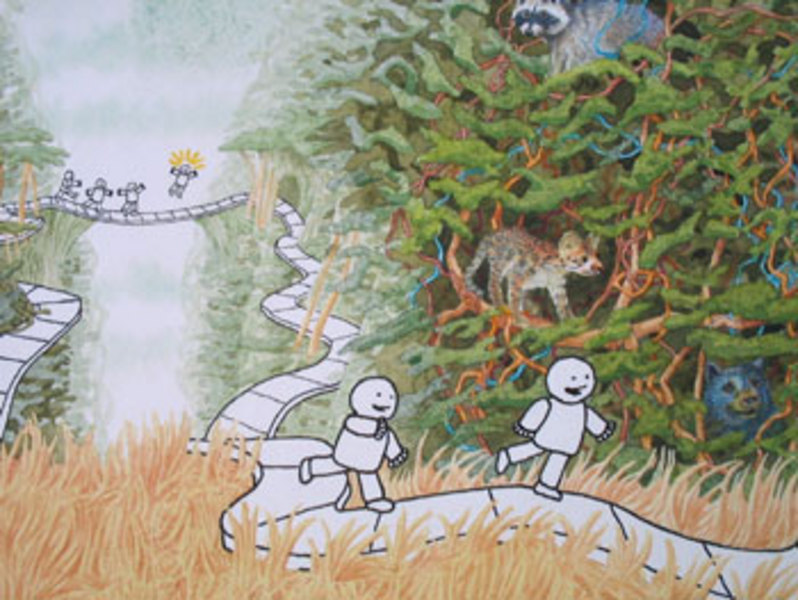
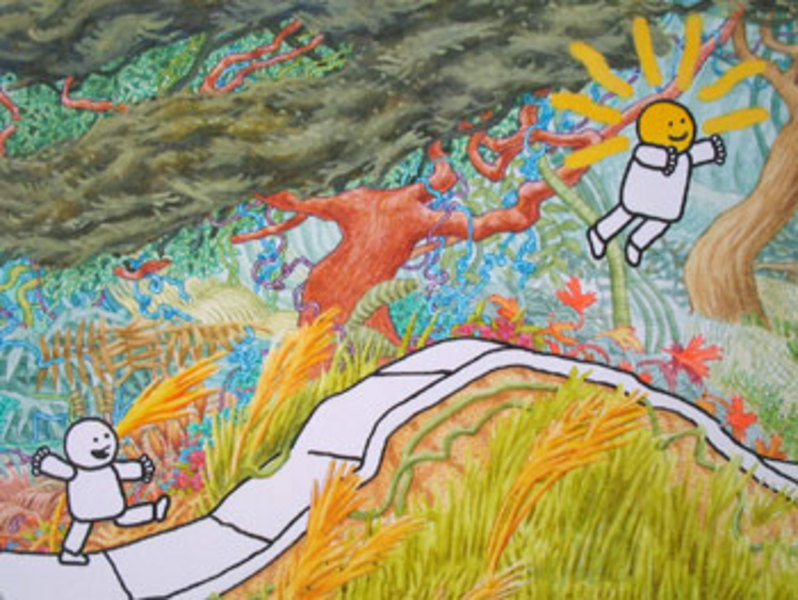
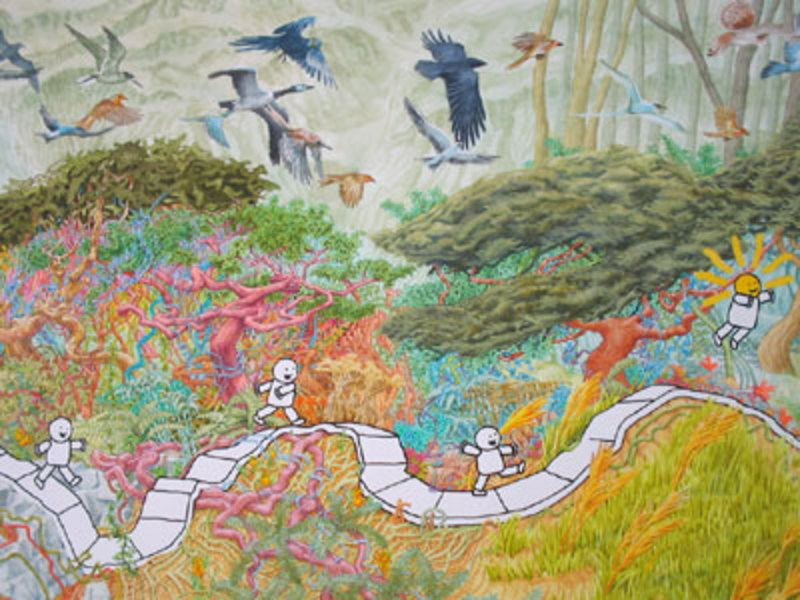
Weller moves the reader from a sad, cold, empty city landscape, into a small splash of color with the first bird, then a bit more color with green grass on either side of the sidewalk, and bits of blue into the sky, into a full riot of color and life and beauty in a breathtaking landscape--multicolored trees, animals, people from various cultures, all together into one magical land. There is so much to feast the eyes on, so many wonderful details to pore over. The colorful, detailed illustrations make the once-empty world seem full of vibrancy, life, and hope, showing what a little imagination can do.
The movement from bleakness to beauty and happiness is like a nourishing meal for the soul. I could spend a long time just looking at the beautiful colors in the tree trunks--purples, pinks, blues, greens, and oranges--never mind everything there is to look at, from monarch butterflies to a turtle to a lion to people from many different cultures, and great trees and sky.
I love how the children, the sidewalk, and the sun-boy remain black-and-white line drawings throughout the book, even amidst the other, more sophisticated color illustrations. As Weller moves the reader into more and more color and beauty, the sidewalk also changes shape, from a straight sidewalk into one that curves and ripples, then moves to connect tree-worlds, and finally breaks apart in the grass.
There is a lot in this book to set the imagination astir, starting with the boy from the sun, whose yellow shining head looks like a small sun, and then moving into the beauty and wonders that the sun-boy brings into the bleakness of the city. The book is a metaphor for imagination--it doesn't matter where you are, or how bleak your surroundings are, you can make them better if you open your imagination and bring beauty to you. This is a wonderful unspoken message in the book. There is also a strong metaphor about the environment, that there is more freedom and happiness and room to play where the land is natural.
The closing illustration is beautiful, with the three children each now having glowing yellow faces like the sun, dancing through the grass with autumn trees swirling leaves around them. The factory is visible in the distance, which suggests that this time, it is the children who brought beauty to their own world, the city world, through their imaginations and hearts. This perfectly sums up the book, and leaves the reader with a sense of satisfaction and good feeling; there is such positive change here, fantasy made reality. I love it.
Though there are a few small things that didn't work for me, most of the book is incredibly beautiful and imaginative; to me it is a masterpiece. If you haven't seen this book yet, I suggest you get your hands on a copy. Highly recommended.
CM Magazine
“Reminds readers to celebrate the human potential”
Boy from the Sun Review by InkyThing
Imagine you are sitting on the sidewalk with your friends and you are bored. The world is grey, and you have nothing to do. Then imagine that a boy comes down out of the sky and puts light and colour into your life!
The Boy From the Sun was one of the first books I read after deciding to create InkyThink. Unfortunately, I didn't buy it at the time, and forgot the title. Lucky for me, my sister worked at a book store, and her co-worker knew which book I was talking about just from my description. It was the last copy, so I bought it right then and there. I adore books like these; where something bad is happening, or someone is having a bad day, and something comes along to turn the world up-side-down, and make it magical again. As you might already know, the inspiration for InkyThink was from wanting never to grow up. I think the reason I like The Boy From the Sun so much is because it is a metaphor for that. I see the sad kids sitting on the sidewalk as adults who have lost their imagination and wonder, and the boy symbolizes what they lost and hope to gain again if they would just let it be a part of their lives. Read The Boy From the Sun when you're having a bad day. It is definitely the book I turn to when I feel blue.