School Library Journal
"...The illustrations perfectly reinforce the somber tone of the story. The soldiers are drawn in grey tones with touches of khaki, against which the robin shines brightly, as does the momentary triumph of the human spirit... Although the incident may be completely fictional, the book stands as a powerful story and could be easily paired with L.Granfield's 'In Flanders fields' or M.Foreman retelling of the 1914 Christmas day cease fire in 'War Games'"
The Midwest Book Review
"... a welcome and highly recommended addition to any family, school, or community library picture book collection... "
CM Magazine
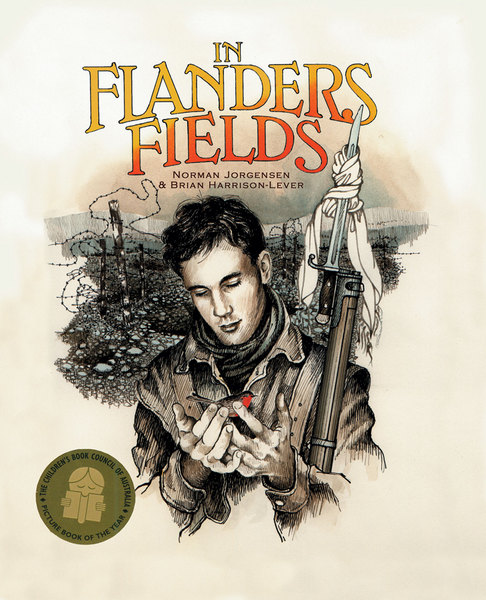
For contemporary children, today's wars, with their imbedded reporters and instant coverage on CNN (with replays) have been largely sanitized of their true horror and may almost seem like benign video games. World War I, aka the Great War or the War-to-End-All-Wars, marked a transition in how wars would be fought. Submarines, airplanes, aerial bombing, tanks and trenches changed the face of combat. It is this "new" conflict that Jorgensen and Harrison-Lever present in In Flanders Fields.
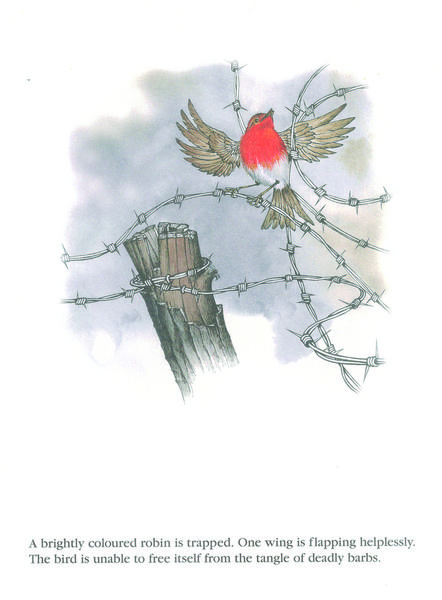
Winner of the 2003 Australian Picture Book of the Year, In Flanders Fields tells the story of a fictional event that occurred on a Christmas Day on the Western Front during World War I. While Canadian readers will recognize the connection between the book's title and the poem of the same name by John McCrae, the bright spot of red in the mud of the battlefield in this book is not a poppy but a robin which has been caught in the barbed wire in no-man's land which separates the Australian and German soldiers.
When a young Aussie soldier who is on watch sees the trapped bird, he attaches a white silk scarf, a Christmas gift from home, to the bayonet atop his rifle. With this flag of truce, he cautiously steps out into frozen battlefield. Both text and illustrations then change perspective as readers see German snipers and a machine-gunner sighting in on the solitary soldier but choosing not to shoot. Returning to the Aussie soldier's point of view, the words and illustrations show him putting down his weapon and releasing the robin which he warns in his hands before it flies away. As the now unarmed soldier walks away from the German trenches, he hears the enemy singing Stille nacht, heilige nacht... and, as he approaches his own trenches, his fellow soldiers continuing the carol, "all is calm, all is bright...."
 Harrison-Lever's pen and ink illustrations, principally rendered in shades of black and brown, capture the squalidness of a landscape that has been repeatedly churned up by constant artillery shelling. The only small splashes of colour come from the embers in the soldiers' small cooking heaters and the tiny red-breasted bird that is ensnared in the wire. Harrison-Lever's illustrations also accurately depict how primitive the conditions in the trenches were during World War I. As well, soldiers' bodies caught in the wire and rats running among the corpses remind readers of what came before these few moments of peace and suggest what will sadly happen again once the tenuous truce is lifted.
Underlining the war theme, Harrison-Lever's front endpapers consist of a view from inside the Australian trenches as the soldiers stand on the firing parapet and look across no-man's land towards the enemy lines. The closing endpapers repeat the scene, but this time from the perspective of the German troops.
Although there was an unofficial truce on the Western Front on Christmas Day in 1914, In Flanders Fields does not refer to that happening. Harrison-Lever's portrayal of the German soldiers wearing "coal scuttle helmets" and his including a destroyed tank on the battlefield, coupled with Jorgensen's mentioning that the unnamed Australian soldier had been gassed, all mean that the book's contents could not have occurred prior to 1916, the year these things were first introduced.
Though a picture book in format, the contents of In Flanders Fields would perhaps be better appreciated by older students who can bring greater understanding to its message.